

Complexity behind geometric floor installations
Feature flooring has become an increasingly important part of modern commercial and interior design. Beyond functionality, floors are now often used to create visual identity, define spaces, and introduce movement within an environment. Geometric tile patterns are particularly effective for achieving this, combining bold design with technical precision.
Projects involving geometric floor layouts require significantly more planning than standard tile installations. Every tile contributes to the overall pattern, meaning alignment and spacing must remain consistent throughout the entire surface. Even small inaccuracies can quickly disrupt the visual flow and symmetry of the design.
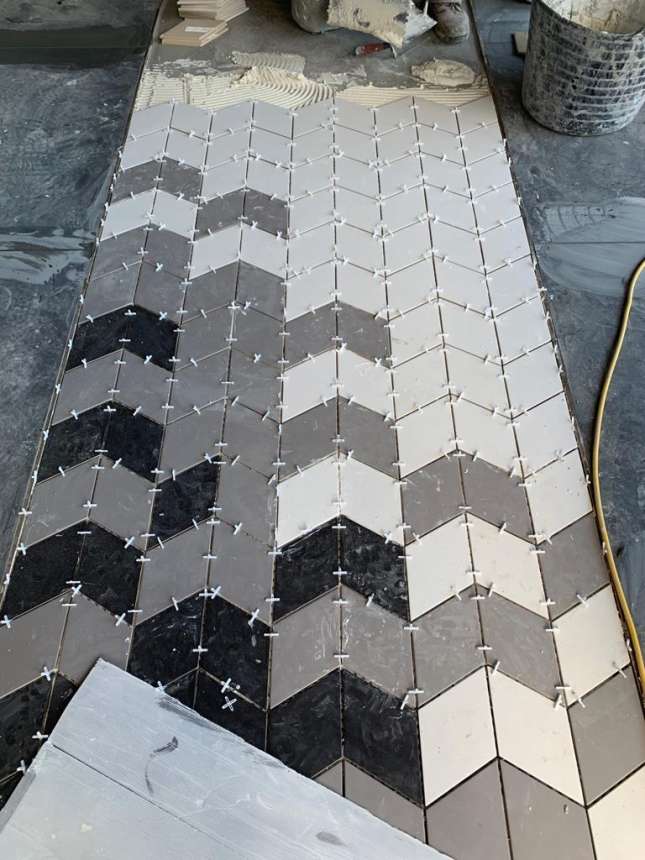
In this installation, the use of a gradient transition adds an additional layer of complexity. The gradual change in tones creates depth and movement across the floor, but it also requires careful coordination to ensure the transition appears balanced and natural. Achieving this effect depends heavily on accurate setting out before installation begins.
Precision cutting and spacing are equally important. Geometric patterns rely on clean intersections and uniform grout joints to maintain their structure. Any variation in spacing or alignment becomes immediately visible, particularly in large open spaces where the pattern can be viewed from multiple angles.
Commercial installations also demand durability alongside appearance. Proper substrate preparation, adhesive selection, and installation techniques are essential to ensure the tiled surface performs reliably under heavy foot traffic and daily use.
Ultimately, geometric floor tiling combines creativity with craftsmanship. When executed correctly, it transforms a functional surface into a key design feature that enhances the entire space while maintaining long-term performance and durability.